ATTITUDE ADJUSTMENT HOUR -- if done correctly also known as HAPPY HOUR (2)
As I mentioned in part 6, the force oval was for a static tire contact patch. The problem is that as you go flying down the road the tire contact patch is continually changing. Therefore the force oval for a particular tire changes dramatically during driving. It gets larger and smaller depending upon how much effective weight is resting on that tire at the moment. An effect of the variable weight on the tire is that the maximum friction that the tire can handle will change dramatically. What this means is that if you quickly reduce the effective weight on a particular tire which is already at its maximum adhesion it will loose traction altogether. This is represented by the reduced size of the force oval. What we have to do is control the attitude of the car in such a way that there is never an abrupt change from one tire contact patch to one of a significantly different size. The way we do this is... you guessed it... by driving smoothly. By driving smoothly we can affect gradual changes in the tire contact patch size.
A complication arises from the fact that we are now dealing with four tire contact patches simultaneously which are inherently associated with each other. To add to the excitement we only have one lump of weight to share among the four tires. By controlling the balance of this lump of weight we can control the tire contact patches of the four tires. One point to remember is that any part of this lump of weight which we apply to a tire means that there is less weight on the other tires.
Different tires bear the loads of different aspects of handling. The front outside tire bears most of the force around a corner. The rear tires bear acceleration forces. The front tires bear deceleration forces. We need to control cornering, accelerating and decelerating forces in concert to create the most effective set of tire contact patches for the maneuver we are undertaking.
First, I'm going to explain the basic balance dynamics and techniques. This part of the discussion is applicable to all corners. Then I will explain the specific techniques for fast and slow corners. When discussing slow corners I'll touch upon Mark Nast's observations about the very tight corners encountered in autocrossing.
Your car will be in five basic attitudes in the course of entering, passing through and exiting a single curve. First, as you're heading down the straight towards the curve all of the tires' force ovals will be at what we will call the home state. This is the same state as when the car is standing still and there is no dynamic weight shifting on the tires. This home condition serves as our static reference point. Any shift from this state means that some force ovals (tire contact patches) will get larger at the expense of others getting smaller.
During the hard braking just before the turn-in point the car's weight will be shifted forward and the front tire force ovals will be larger than the home state. The trade-off is that the rear tire force ovals will be smaller than the home state.
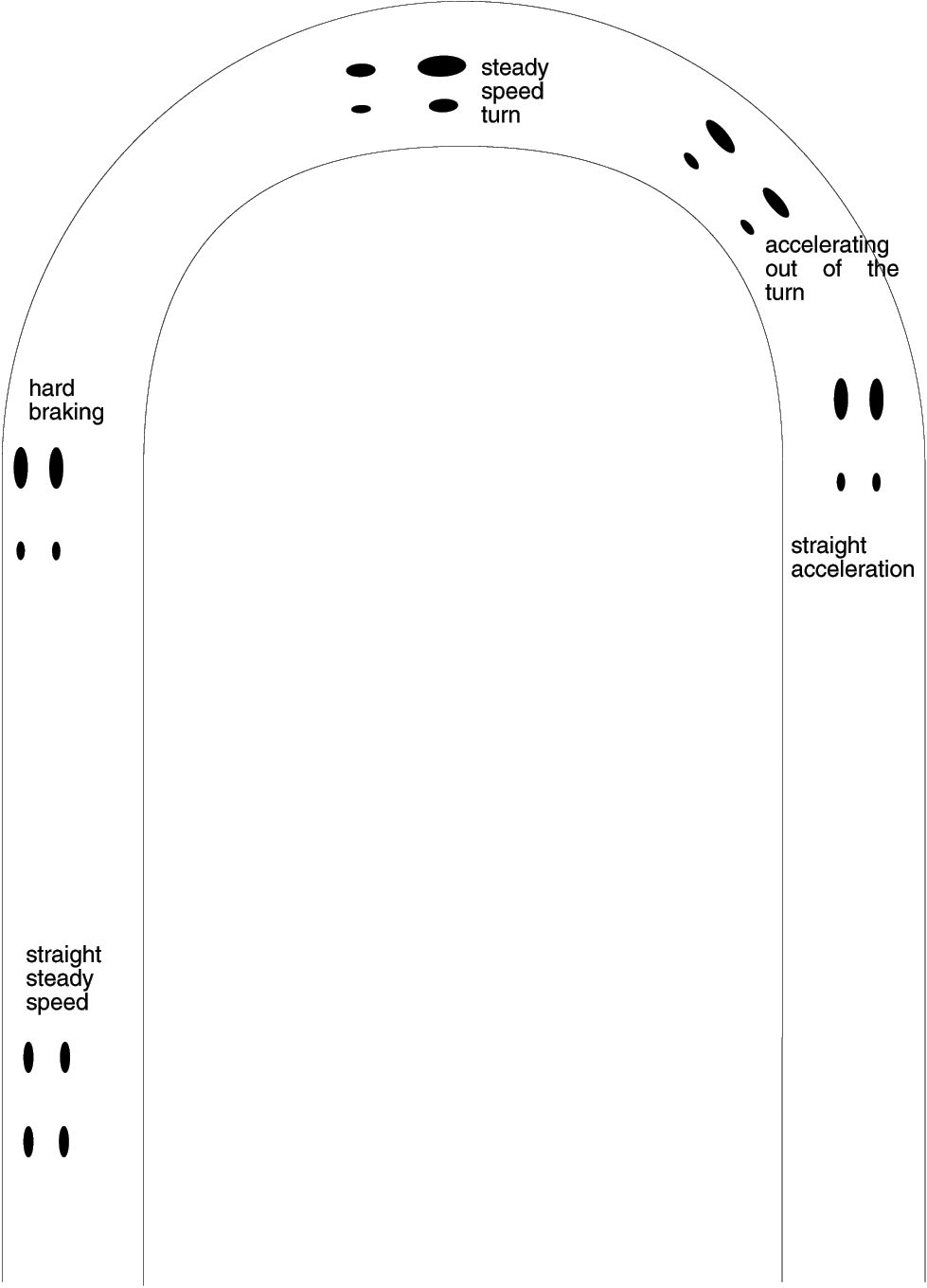
Attitude three is when the car is in the turn at a steady speed, no acceleration or braking. In this state the front outer tire has a larger than standard force oval. The rear inner tire has a smaller than standard force oval. The other two tires are at some point in between these extremes.
The fourth state occurs as we start to accelerate out of the curve. Acceleration causes weight to shift towards the rear. Therefore, the rear tire force ovals both get larger, and the front tire force ovals get smaller.
In state five the car is in straight acceleration and the two rear force ovals are the same and larger than normal. The two front force ovals are the same and are smaller than normal.
Now we want to shift the weight so that we can maximize tire contact patches where we can best use them while not sacrificing the other patches. Whatever the manuever is which we are attempting, all four tires need to grip the road.
As you enter the corner you will be braking hard and the majority of the weight of the car will be on the front tires. This will work out to your benefit since you want your front outer tire to have a large contact patch. It will bear the brunt of the cornering work.
At the turn in point you will be moving at the slowest speed that you will hit during the whole curve. After the turn in point you start to accelerate, but the trick is not to lose the front outer tire contact patch. When you accelerate the weight of the car shifts to the rear. What you want to do is accelerate while keeping the weight balanced towards the front.
Instead of releasing the brakes completely as you start to accelerate, slowly ease off the brakes as you accelerate. Again, the heel and toe technique is how you accomplish this. This will keep the weight biased towards the front where you need it the most. If you were to jump on the throttle the weight would shift to the rear and you would lose the traction you need for the turn. Gradually accelerate and lessen your braking simultaneously as you go through the corner. You should feel the chassis settle into a solid stance as you accelerate through the bend.
Next part I will discuss the techniques for slow and fast corners. I want to clse with some "just in case" techniques which should have been mentioned earlier.
A QUICK EXCURSION
I want to touch on some emergency situation techniques. This doesn't fit here as far as handling is considered, but it's good to have in mind whenever you're driving.
When all is lost and you're getting a quick panoramic view of your surroundings, apply the full brakes until you've completely stopped. Too many times in the history of motor sports has a spinning car scrubbed off enough speed for the tires to regain traction only to go shooting off perpendicular to the road into the barriers.
When there is nothing more you can do to avoid a crash and you're just about to hit whatever you're going to hit, take your hands off of the wheel so that your wrists aren't damaged by any kick in the steering wheel as the front suspensions makes contact. Also, pull your legs up as much as possible in the hope that the damage won't reach where your feet are.
2 This discussion applies to rear wheel drive, four-wheeled vehicles. I have not considered the dynamics of front wheel drive or four wheel drive vehicles and am not going to attempt to cover handling techniques for such.
 Flying Title Page